The Accent Question: Should You Worry If Your Kid Has a "Non-Native" Accent?

Your daughter speaks beautiful Mandarin. She can tell elaborate stories, joke with her grandparents, and switch between languages effortlessly. But there's one thing that bothers you: her Mandarin has a noticeable English accent. When she visits family in Taiwan, relatives comment on it. When she speaks, you can hear the American influence in her tones.
And you wonder: does this accent mean she's not really fluent? Have you failed at passing on your language "properly"? Should you be doing more to correct her pronunciation?
Let's talk about the accent question—one of the most misunderstood aspects of raising bilingual children. Because the truth is, accents are far more complicated and far less important than most parents think.
Understanding what accent really means
First, let's clarify what we're talking about. An accent is the way someone pronounces words in a language, influenced by their native language, regional background, or the linguistic environment where they learned to speak. Everyone has an accent—there's no such thing as speaking without one.

For bilingual children growing up in multilingual environments, developing what linguists call a "heritage speaker accent" is completely normal. This is when someone is fluent in a language but their pronunciation reflects influence from their other language or the linguistic environment where they grew up.
Your Mexican-American child might speak Spanish fluently but with phonological features influenced by English. Your French-Canadian child might speak French with pronunciation patterns that differ from those in France. This doesn't mean they speak incorrectly—it means they speak like bicultural, bilingual individuals, which is exactly what they are.
The distinction between fluency and accent
Here's the most important thing to understand: linguistic competence and phonological accuracy are not the same thing.
Linguistic competence is your child's actual knowledge and use of the language—their vocabulary, grammar, ability to understand and produce complex sentences, pragmatic skills, and capacity to communicate effectively.
Phonological accuracy is how closely their pronunciation matches that of monolingual native speakers from a specific region.
Research in bilingualism has consistently shown that these two things don't necessarily go together. You can be highly fluent with a noticeable accent. You can have excellent grammar, extensive vocabulary, and sophisticated language use while still pronouncing words differently than monolingual speakers.
Think about adults who learn a second language well. Many are fluent, professional, articulate speakers who retain an accent. That accent doesn't diminish their linguistic competence—it's simply a feature of their speech.
The same is true for bilingual children. The presence of an accent tells you nothing definitive about your child's actual language ability.
Why bilingual children develop accents
Understanding why heritage speaker accents develop can help ease your worry about them.

Timing and input matters: Children's accent in a language is heavily influenced by when and how they learn it. If your child acquires both languages simultaneously from birth, they may develop pronunciation patterns that blend features of both. If they learn the heritage language primarily at home but the majority language in school and community, the majority language often influences their heritage language accent.
Quantity of exposure: The sheer amount of input in each language affects pronunciation. If your child hears English 70% of the time and Korean 30% of the time, their English pronunciation tends to be more established, which can influence how they pronounce Korean sounds.
Age and phonological development: While young children are generally better at acquiring native-like pronunciation than older learners, bilingual children's phonological development happens across two language systems simultaneously. This can result in unique pronunciation patterns that don't match either monolingual norm perfectly.
Social and identity factors: As children become more socially aware, they may unconsciously (or consciously) adopt pronunciation patterns that reflect their peer group and social identity. A teenager might speak their heritage language with an accent that signals their bicultural identity to friends.
Limited correction: Unlike grammar or vocabulary, pronunciation is rarely explicitly taught in family settings. Children learn it through exposure and imitation. If they have limited models of the heritage language or primarily interact with other heritage speakers who also have accents, those pronunciation patterns become established.
Accent and identity: The part nobody talks about
Here's the aspect of accent that's often overlooked: accent is deeply tied to identity. The way your child speaks doesn't just reflect their linguistic input—it reflects who they are.

When your Korean-American child speaks Korean with an American accent, they're not speaking "bad Korean." They're speaking Korean as a Korean-American person—and that's a legitimate identity. When your French-Canadian child's French doesn't sound like Parisian French, that's because they're not Parisian—they're French-Canadian.
Bilingual children occupy a unique cultural and linguistic space. They're not monolinguals from the heritage country, and they're not monolingual speakers of the majority language. They're something different and equally valid: bicultural, bilingual individuals with their own linguistic identity.
When we pressure children to sound exactly like speakers from the "home country," we're implicitly sending a message that their bicultural identity isn't legitimate. We're suggesting they need to choose one linguistic identity over the other, when the whole point of bilingualism is that they can be both.
When does accent actually matter?
Let's be practical. In what situations does accent actually affect your child's life?
Communication and comprehension: This is the most important factor. If your child's accent interferes with comprehension—if family members genuinely can't understand them, or if they struggle to make themselves understood—that's worth addressing. But an accent that people notice but that doesn't impede communication? That's not a problem.
Social acceptance and belonging: Unfortunately, accent can sometimes affect how bilingual children are perceived by both heritage community members and majority language speakers. They might be judged as "not authentic enough" by monolinguals from the heritage country, or stereotyped by majority language speakers. This is real, and it can hurt. But this is a problem with social prejudice, not with your child's language skills.
Professional contexts: In some career paths, particularly those involving public speaking, media, or customer-facing roles, accent can potentially limit opportunities due to bias. However, this varies enormously by field and location, and accent discrimination is increasingly recognized as problematic.
Personal comfort and confidence: If your child feels self-conscious about their accent or if it affects their willingness to speak the heritage language, that's worth taking seriously. Language confidence matters for maintenance.

Here's the key point: in most situations, accent matters far less than we think it does. People understand speakers with accents all the time. Successful communication happens across accent differences constantly. What matters most is whether your child can express themselves and connect with others.
What linguistics research tells us
If you're still worried, here's what research on bilingualism and heritage speakers actually shows:
Studies have found that heritage speakers—bilingual individuals who grew up speaking a minority language at home—often have excellent implicit knowledge of their heritage language even when their pronunciation differs from monolinguals. They can produce complex grammar, understand subtle cultural nuances, and use language appropriately in context.
Research on accent perception shows that "native-like" pronunciation is not necessary for fluent communication. Listeners adapt quickly to accented speech, and comprehension is rarely affected by accent alone unless the accent is extremely strong or combined with other language difficulties.
Linguists also emphasize that there's no single "correct" accent even within a language. Languages have regional variations, social class variations, and generational differences in pronunciation. The Spanish spoken in Mexico differs from that in Spain, which differs from that in Argentina. Who's to say which accent is "right"?
Heritage speakers constitute a legitimate speaker population with their own linguistic norms. Your child isn't speaking "incorrect" Spanish—they're speaking heritage Spanish, which is a recognized variety of the language.
Supporting pronunciation without creating anxiety
If you want to support your child's pronunciation in their heritage language, here are approaches that help without creating self-consciousness or shame:
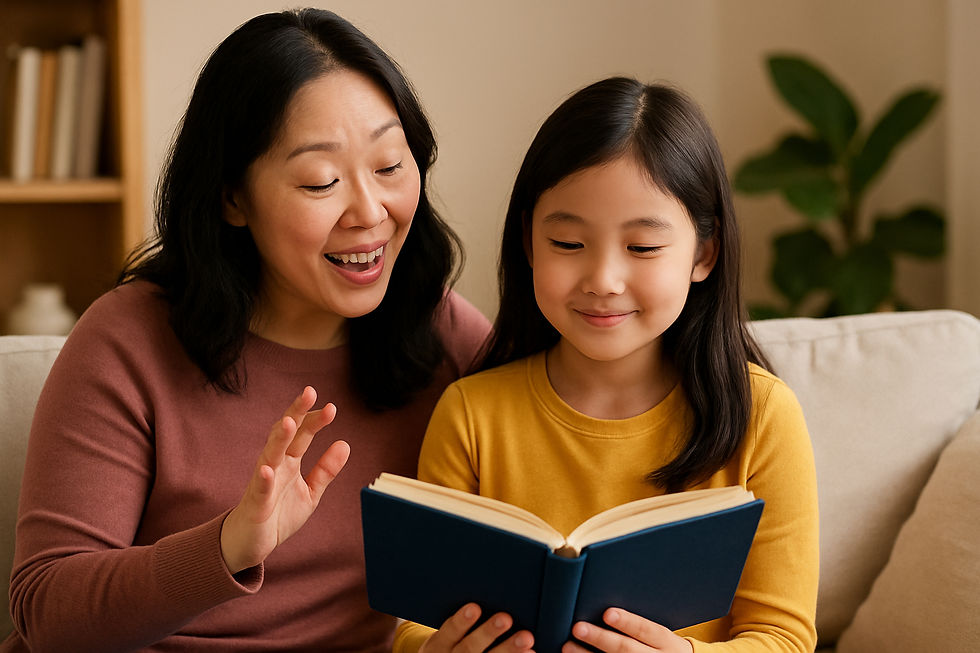
Model without correcting: When your child mispronounces something, simply use the correct pronunciation naturally in your response. If they say a word with an accent, you repeat the word with standard pronunciation in your reply. This provides modeling without explicit correction, which tends to work better for pronunciation.
Use songs and rhymes: Music and rhythmic language naturally support pronunciation development. Songs help children internalize the prosody and phonological patterns of the language without it feeling like drill work.
Increase exposure to diverse speakers: The more your child hears the heritage language from various speakers, the more opportunities they have to refine their pronunciation naturally. This might mean more time with extended family, watching shows featuring multiple speakers, or participating in community activities.
Play with sounds: Make language play fun. Create silly rhymes, practice tongue twisters together, play with alliteration. When pronunciation practice feels like a game rather than correction, children engage with it willingly.
Respect their comfort level: If your child is self-conscious about their accent, pushing pronunciation practice can backfire. Prioritize communication and confidence over perfect pronunciation. A child who speaks willingly with an accent is better off than one who refuses to speak because they're worried about sounding "wrong."
Address social concerns thoughtfully: If your child is being teased or criticized about their accent, talk with them about linguistic diversity and validate their bicultural identity. Help them develop responses to comments and ensure they understand that their way of speaking is legitimate.
The importance of perspective
Here's what might help put the accent question in perspective: among adults, we generally accept that people can be bilingual even with accents. We don't tell professional interpreters they're not really bilingual because they have an accent in one language. We don't say immigrants who speak excellent English with an accent aren't fluent.

So why do we hold bilingual children to a higher standard? Why do we expect them to sound exactly like monolinguals from the heritage country when that's not even who they are?
Your child is growing up in a different linguistic environment than you did. They're navigating two languages, two cultures, and forging their own bicultural identity. The way they speak reflects their unique experience—and that's something to celebrate, not fix.
What to say when family criticizes
Many parents struggle with relatives who comment on or criticize their child's accent. Here's how to respond:
"Their pronunciation reflects that they're growing up bilingual in [current country]. They're speaking like the bicultural person they are."
"I'm proud that they can communicate in both languages. That's what matters most."
"Actually, linguists say heritage speaker accents are completely normal and don't indicate any language deficit."
"Please don't make comments about their accent. It makes them self-conscious and less willing to speak [heritage language]."
You can be polite but firm. Your child's linguistic confidence is more important than relatives' opinions about pronunciation.
The bottom line: Communication over perfection
Your bilingual child's accent—whatever it may be—is a feature of their speech, not a flaw. It reflects their bicultural, bilingual identity. It tells the story of where they grew up and the linguistic environment that shaped them.
What matters is not whether your child sounds exactly like a monolingual speaker from your home country. What matters is whether they can communicate, connect with family and community, and feel confident expressing themselves in both their languages.
Fluency is about the ability to use language effectively—to understand, to be understood, to express complex ideas, to connect with others. An accent doesn't prevent any of this.
So when you catch yourself worrying about your daughter's American accent in her Mandarin, or your son's English influence in his Arabic, remember: they're not failing at bilingualism. They're succeeding at being themselves—bicultural, bilingual, and beautifully unique.
Their accent doesn't need to be fixed. It needs to be accepted as part of who they are.
Looking for more support on your bilingual journey? Explore our other articles on raising multilingual children, or join our Reddit community of families celebrating bilingual identities in all their diversity.


Comments